Lovable.dev is not my thing
Urania Logico - tech ENI really wanted to like Lovable.dev, I swear.🫠
The promise was compelling: fast product builds, AI-assisted creation, streamlined workflows, less technical overhead. For solo founders and small teams, that sounds like a dream.
But after actually using it and particularly alongside Shopify (not premium) my experience was frustrating enough that I wouldn’t recommend it.
The Problem With “Vibe Coding”
Lovable leans into what people now call “vibe coding”, prompting your way into a product. You describe a feature, tweak the tone, adjust the layout, regenerate sections, and slowly shape something that looks right.
The problem is that “looking right” is not the same as being structurally sound.
Vibe coding optimizes for momentum and aesthetics, not architecture. It feels productive because things appear quickly. Pages render. Components exist. Flows look coherent. But under the surface, the logic often lacks intentional structure. Naming conventions drift. Patterns aren’t always consistent. Generated solutions solve the immediate prompt but don’t necessarily respect long-term scalability.
When you try to evolve the project, introduce more complex state handling, or integrate third-party systems, you start fighting the very scaffolding that initially felt empowering.
Another issue is ownership clarity. When code is heavily AI-generated, debugging becomes interpretive. You didn’t fully design the system; you negotiated it into existence. That makes reasoning about edge cases harder. Instead of understanding why something works, you’re probing it to see how fragile it is.
For landing pages or prototypes, this might be acceptable. But once the project moves from experimentation to infrastructure, the lack of deliberate architecture becomes a liability.
The Interaction Feels … Boring
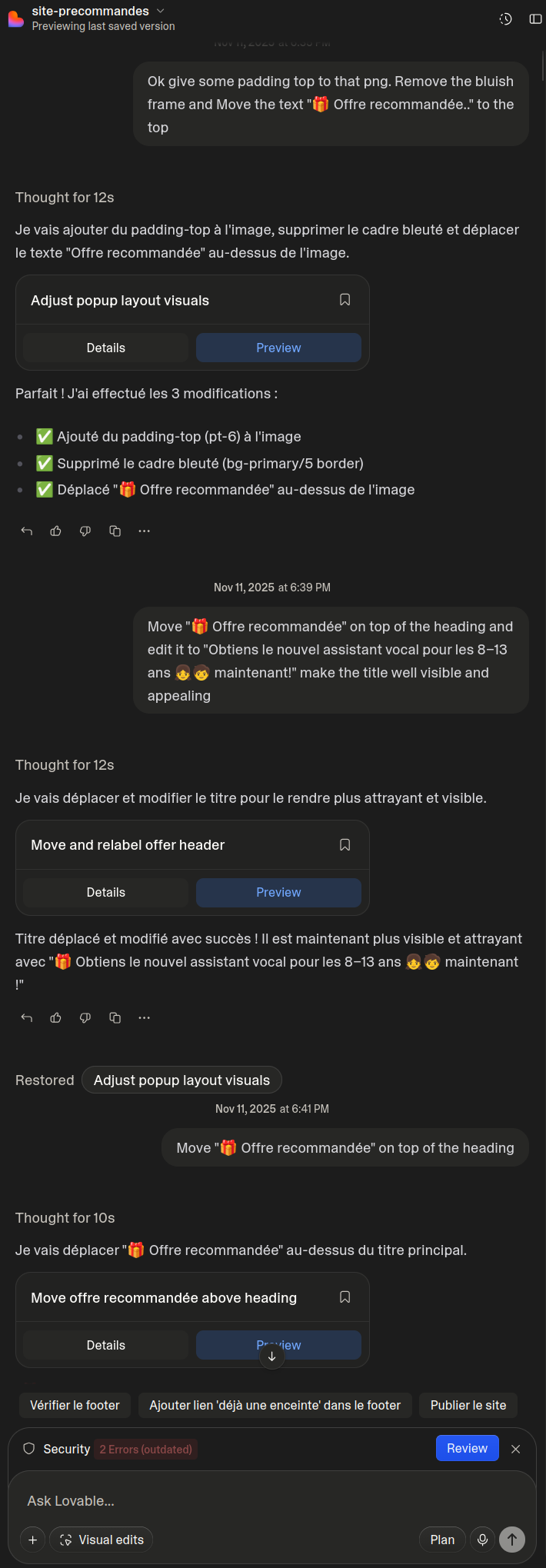
Rather than being creative and empowering, working with Lovable’s prompts became repetitive and dull.
You repeat variations of the same instructions: “move this,” “add that,” “use this color here,” “adjust spacing there.” What was advertised as a fluid creative process quickly felt like form-filling: prompt, wait, tweak, repeat. It wasn’t brainstorming with a tool, it was negotiating with a spinner.
Editing constraints felt rigid, not expressive. Small tweaks often obliterated previous work. And you use your credits. Aprox 0,25 per prompt.
Instead of feeling like I was building a product, I felt like I was editing someone else’s rough draft.
The Shopify Friction
Combined with Shopify, it becomes problematic.
Shopify isn’t just a storefront tool, when you add Lovable as an abstraction layer on top of Shopify, you introduce distance between your business logic and the system that actually runs your business.
That distance shows up in subtle but serious ways. Product syncing becomes something you have to trust rather than verify. Variant behavior can feel opaque. Metafields and custom logic stop being straightforward extensions and start feeling like negotiation points between systems. When something doesn’t behave correctly, you’re no longer debugging one platform, you’re debugging the relationship between two.
With Lovable layered in, accountability becomes diffused. If checkout behavior is inconsistent, is it Shopify’s configuration? Is it a sync issue? Is it generated logic from Lovable that doesn’t fully align with Shopify’s model?
Abstraction can be powerful when it simplifies complexity.
Conclusion
Lovable isn’t a bad idea. It’s fun for short bursts. It gets you something fast.
The interaction model is dull and repetitive rather than empowering. The pricing structure pushes you to pay for the least painful experience, which is the very experience that should be baseline. And on real commerce stacks like Shopify, the abstraction creates confusion rather than clarity.
If you’re building serious products that need durability and predictability, Lovable isn’t the tool I’d bet on.
For prototypes? Maybe.
M2C